It’s Time for Swamplot To Say Goodbye
http://swamplot.com/its-time-for-swamplot-to-say-goodbye/2019-03-07/
As of today this site’s daily publishing schedule is coming to a halt. Swamplot has been covering Houston’s real estate landscape for 12 years. That’s longer than the runs of most successful teevee sitcoms, all but one U.S. presidency, and a lot of great Houston restaurants. It’s been long enough to cover 3 hurricanes, several boom-and-bust cycles, a half-dozen or so 100-year floods, and the rise and fall of Tuscanization. More than a few high-school freshmen when Swamplot started in 2007 are now armed with PhDs and ready to launch their careers. It’s time for us to move on as well.
We’re proud of what Swamplot has accomplished: the reporting it’s assembled; the commenters, readers, contributors, and tipsters it’s attracted; the conversations and reconsiderations it’s fostered; the groups of people from different walks of life it’s brought together in some way; the coinages you’ve come up with; and the community that’s been built here around the notion that our local built and natural environments are worth our attention and our jokes.
Houston has always been a funky town. It’s rarely been served well by those who ignore that, or who promote it with a chip on their shoulder, or who build in it without recognizing the profound handicaps and weirdnesses that continue to shape it. In Swamplot’s dozen years of documenting the odd details of its growth and destruction, we’ve noticed a gradual but steady change of attitude — one that we hope we’ve helped to effect: People here, we get a sense, now pay more obvious attention to the things that make Houston unique, bizarre, wacky, frustrating, and lovable. If Swamplot has, in any way, played a role in altering your sense of this place — by reporting on things normally paid little attention to, by presenting things in ways you wouldn’t otherwise expect to see them, by dangling in front of you the comments and perspectives of people who see this city very differently from the way you do, or by striving each day to highlight the absurdities that underly and shape so much of the Houston experience — well, then hanging out with y’all for some or all of this time has been well worth it.
Beginning next week, we’ll have a few announcements and questions to post here about Swamplot’s past, present, and future — so please do come back and visit to see what’s up. For now, though, we want to thank you — our readers, commenters, tipsters, photographers, advertisers, sponsors, and contributors — for making Swamplot what it’s been, and maybe making Houston a little bit better place for us all.
Photos: Russell Hancock (aerial); Bill Barfield (sign) via Swamplot Flickr Pool
… Read More
By: Swamplot Title: It’s Time for Swamplot To Say Goodbye Sourced From: swamplot.com/its-time-for-swamplot-to-say-goodbye/2019-03-07/ Published Date: Fri, 08 Mar 2019 00:00:52 +0000
" I begin praying and imagining as well as composing and also scraping on the wall in front of me. The fire is my sole source of light. The power and also Voice of God are my single sources of motivation.".
Traveling Far.
Priest Steve Bonenberger circa 2020.
Steve Bonenberger,. Executive Supervisor,. St. Alegis. 1-760-707-7051.
Top 10 Worst Environmental Decisions in California’s History
https://legal-planet.org/2020/05/07/top-10-worst-environmental-decisions-in-californias-history/
California has a paradoxical history with its environment. On one hand, the state boasts incredible natural beauty, along with a government that is an internationally recognized leader for strong environmental policies. But the state’s residents have also caused severe environmental destruction, particularly in the late nineteenth century — some of which helped spur the mobilization that led to these environmental successes.
Looking at California’s history, what were some of the most striking examples of environmental destruction? To qualify for this “Top 10” list, the destruction had to be irreparable (at least in anyone’s lifetime) and of a uniquely beautiful environmental feature (landscapes and plants). Of note, animals are not included, nor is an assessment of the economic trade-offs or alternatives.
10. Quarrying Morro Rock
Morro Rock is California’s Gibraltar, a striking coastal feature just north of San Luis Obispo on Morro Bay. It’s a remnant, exposed rocky volcano, visible from miles away. The local Chumash tribe consider it a sacred site (named Lisamu) and have special access to the top for religious ceremonies. But half of the side of the rock was quarried from 1889 to 1969 to form the bay breakwater, leaving a massive scar.
9. Draining the Owens Valleyand Mono Lake
The Owens Valley is a remarkable north-south valley created by fault separation along the eastern Sierra Nevada mountains. Just past the northern end of the valley lies Mono Lake, an ancient salt-water body of water. In the early 1900s, Los Angeles city leaders surreptitiously purchased land and water rights to direct the Owens river, and eventually the streams supplying Mono Lake, into aqueducts to service Los Angeles real estate development. The result was a shrunken Mono Lake and desiccated Owens river valley and lakebed, creating toxic duststorms and economic and environmental blight in the region.
8. Channelizing the Sacramento-San Joaquin Bay Delta
The Delta sits between California’s Central Valley and San Francisco Bay, draining most of the water from the interior of the state to the Pacific Ocean. It is one of the largest estuaries in western North America, once featuring a vibrant ecosystem with rich soil. Chinese laborers were employed to build levees between the 1850s and 1870s to dam and farm the land. Today, these levees are at constant risk of collapse, jeopardizing much of the state’s water transfer system from north to south, while much of the Delta ecosystem is in a state of freefall.
7. Clear-Cutting the Sierra and Lake Tahoe Pine Forests
The Sierra Nevada mountains used to be blanketed in old growth pine forests, which included trees the size and age of giant sequoias in some cases. But in the mid- to late-nineteenth century, much of the mountains, including the entire Lake Tahoe basin, was clear cut largely to build underground silver mines in neighboring Nevada. Today, the resulting second-growth forests of clumped juvenile firs and pines creates a fire-prone jumble that forest officials are struggling to manage properly. You can still see the original old-growth pines only in places like DL Bliss State Park along Lake Tahoe, ironically preserved by one of the industrialists who profited from the logging in the first place.
6. The Los Angeles Freeway Embrace
The City of Los Angeles is ringed by semi-arid mountains, distant snow-capped peaks and a long coastline featuring wetlands, coastal bluffs and sandy beaches. Yet in the middle of the twentieth century, city and state leaders enabled the paving of much of this landscape via the construction of multiple large freeways, starting with the Arroyo Seco Parkway in Pasadena, the first freeway in the country. This automobile network induced significant traffic congestion and sprawling development that to this day generates a substantial amount of air pollution, despite efforts to retrofit the city back to a Railtown.
5. Damming Hetch Hetchy Valley
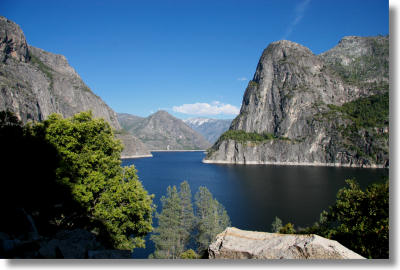
Hetch Hetchy is a rare glacial-carved valley within Yosemite National Park in the Sierra Nevada, featuring a meandering Tuolumne River and similar in scale and beauty to the more-famous Yosemite Valley to the south. San Francisco water engineers at the turn of the last century sought to dam this bathtub-shaped valley to bring mountain water to the groundwater-challenged San Francisco peninsula. Over the objections of John Muir and the Sierra Club, the federal government and San Francisco officials approved the dam, flooding and permanently marring this geologic wonder.
4. Logging Giant Sequoias
Giant sequoia trees can live up to three thousand years and grow to become the largest living things on Earth. California’s western Sierra Nevada mountains host the last remaining 77 groves on Earth. In the late 1800s, Californians chopped down about one-third of them. Worse, most of the wood from the trees would shatter on impact with the ground, so these residents could only use the wood for building fences or manufacturing shingles.
3. Wetlands Destruction
California once boasted over 4 million acres of wetlands, out of 163 million in the state, from coastal lagoons to Central Valley floodplains. These lands featured abundant bird and aquatic life, among other features. But 90 percent of them were destroyed by river damming and channelization. Today, what remains hosts 55% of the state’s endangered species, with much of those lands now irreparably lost to farms, cities and sprawl.
2. Clear-Cutting Old-Growth Coastal Redwoods
Coastal redwood trees grow to be the tallest living things on Earth and can live up to two thousand years. They are located along California’s coast up to the Oregon border. But starting in the mid-nineteenth century through the 1980s, loggers cleared 95% of the original old growth forests. Once cut, new trees may quickly grow up in a ring around the old stump but resemble toothpicks compared to the originals. To view what was lost, you can visit Muir Woods 12 miles from San Francisco, Big Basin Redwoods State Park near Santa Cruz, or Redwood National Park near the Oregon border.
1.Hydraulic gold mining
Malakoff Diggins State Park in Nevada City, California
In the mid-1800s, mining companies discovered that they could harvest gold from the Sierra Nevada foothills more easily if they blasted the rock with high-pressure water. In a few short years, these companies denuded and deformed much of the Sierra foothills, sending debris into the Central Valley and mercury pollution into the San Francisco Bay, where it still sits today. A federal judge stopped this type of mining in the 1884 decision Woodruff v. North Bloomfield Gravel Mining Company, in order to protect agricultural land in the Central Valley. But much damage was permanently done to the foothills, agricultural areas of the Central Valley and San Francisco Bay water quality.
There are potentially many other examples of harmful environmental decision making to choose from, which you can suggest in the comments. The one upside of many of these tragedies is that they resulted in a public backlash that inspired long-lasting environmental reform and organizations, with compounding successes to this day. Much of the destruction described here could have been far more significant without this citizen (and often business) mobilization. But still, what is lost is forevermore, a cautionary tale that should give us pause before we sacrifice any more of California’s environmental heritage.
By: Ethan Elkind Title: Top 10 Worst Environmental Decisions in California’s History Sourced From: legal-planet.org/2020/05/07/top-10-worst-environmental-decisions-in-californias-history/ Published Date: Thu, 07 May 2020 14:50:36 +0000
Maida Law Firm - Auto Accident Attorneys of Houston
Porsche Exclusive Manufaktur: Icons of Cool
https://www.youtube.com/watch?v=DD9nXlMw2R8
Icons of Cool. The 911 Speedster with Heritage Design package led the way in 2019. See our inspiration for the upcoming launch of the first of four Heritage Design special models and get involved with the lifestyle of the Porsche across '50s, '60s, '70s and '80s.
#PorscheExclusiveManufaktur #IconsOfCool #Porsche
__
911 Speedster: Fuel consumption combined: 13,8 l/100 km; CO2 emissions combined: 317 g/km
Follow Porsche on Instagram: https://porsche.click/2R1FOPM
Like Porsche on Facebook: https://porsche.click/3dFSRQs
Subscribe to Porsche on YouTube: https://porsche.click/2WWDxZZ
Visit the Porsche Website: https://porsche.click/2yprQAR
*Weitere Informationen zum offiziellen Kraftstoffverbrauch und den offiziellen spezifischen CO2-Emissionen neuer Personenkraftwagen können dem 'Leitfaden über den Kraftstoffverbrauch, die CO2-Emissionen und den Stromverbrauch neuer Personenkraftwagen' entnommen werden, der an allen Verkaufsstellen und bei und bei der Deutschen Automobil Treuhand GmbH unter http://www.dat.de/?sf118523178=1 unentgeltlich erhältlich ist.
https://www.stevebonenberger.com/
When Stunning Creatives Gather | Bonenberger and Co
I am a Creative.
I am a post-normal.
I am a candidate of the yet to be discovered.
Creatives:.
Those who see form and envision enhancement.
Those that contour the blasé.
Those that install movement.
Those strong demure that dare to imagine vibrant distinction.
Those that hold stillness as relationship.
Those who dabble with abstract types.
Those who see outcomes as open-ended.
Those that smash glass ceilings.
Those who embrace expatriation.
Those who get pen, brush, craftsmen's wheel and also hammers.
Those that stray into fields of marvel.
Those who distribute wanderlust.
#Writing #Poet #Life.
Do Epidemic-Based Business Closures by Government Trigger an Unconstitutional “Taking”?
https://legal-planet.org/2020/05/07/do-epidemic-based-business-closures-by-government-trigger-an-unconstitutional-taking/
Lately, an increasing number of public and private voices have been raised in opposition to business closures ordered by state and local governments in response to the COVID-19 epidemic. In many such cases, that opposition has taken the form of lawsuits filed by business owners, claiming a violation of their constitutional rights. Gun shops across the country, for example, have sued to reopen their businesses, claiming that government closure orders contravene the Second Amendment-based right to bear arms.
Indeed, the epidemic has seemingly launched a whole new legal practice area: coronavirus lawsuits. In California, San Francisco attorney Harmeet Dhillon has emerged as the apparent queen of COVID-19 litigation, seemingly ready to bring any number of lawsuits against state and local governments on behalf of business interests based on a multitude of constitutional theories.
One of the most prevalent such claims is that government-mandated closures of private businesses violate the latter’s private property rights protected under the Fifth Amendment’s “Takings Clause”; business owners assert they’re therefore entitled to financial compensation from the state or local governments. Small business owners in Pennsylvania, for example, have relied on the Takings Clause to sue that state’s Governor, Tom Wolf, who in March ordered the closure of non-essential Pennsylvania businesses based on public health concerns arising from the epidemic. In California, the aforementioned Ms. Dhillon recently brought a lawsuit on behalf of retail business owners against Governor Gavin Newsom, Los Angeles Mayor Eric Garcetti and other government leaders, alleging that their shelter-in-place orders violate the owners’ constitutionally-protected property rights and trigger a compensable, “regulatory taking” of their businesses.
How likely are these takings lawsuits to prevail? The answer: not likely at all.
Recently, U.C. Berkeley School of Law Dean and constitutional scholar Erwin Chemerinsky gave a presentation to a group of federal and state court judges regarding epidemic-related constitutional issues, and the likelihood that lawsuits raising such constitutional claims would be successful. Takings Clause-based claims were one category of constitutional challenges Dean Chemerinsky analyzed and ultimately dismissed. He cited a pair of Korean War-era U.S. Supreme Court decisions that had rejected Takings Clause-based challenges to the federal government’s seizure and redeployment of private factories to assist the war effort.
I agree with Dean Chemerinsky that Takings Clause-based lawsuits challenging business closures in the face of the current epidemic are quite likely without legal merit. And I offer some additional thoughts on the subject:
Another so-called “possessory takings” case that courts might well find relevant to their disposition of epidemic-based business closure cases is the California Supreme Court’s 1995 decision in Customer Company v. City of Sacramento. In that case, an armed robbery suspect took refuge in a convenience store when the local law enforcement arrived, and refused to surrender. Police fired tear gas into the store, which had the desired effect of disabling the robber and allowing his capture. But in the process substantial damage was done to the foodstuffs and other inventory of the store. The Supreme Court rejected the store owner’s lawsuit claiming that the law enforcement response triggered a requirement to pay the owner compensation under the Takings Clause for its economic losses. Said the court: “just compensation has…never been applied to require a public entity to compensate a property owner for property damaged resulting from the efforts of law enforcement officers to enforce criminal laws.” The analogy to a severe public health emergency seems persuasive, at least to this observer.
Even more instructive are past takings claims arising out of government efforts to prevent the spread of disease. Nearly a century ago, for example, the U.S. Supreme Court unanimously held in Miller v. Schoene that the Takings Clause did not require the State of Virginia to compensate the owner of cedar trees for the value of the trees that the state ordered destroyed to prevent a disease from spreading to nearby apple orchards that were vital to the regional economy.
However, I believe that even more apt–and dispositive–are property rights cases that don’t concern government possession or physical destruction of private property but, rather, involve government regulation of private property interests. In general, government defendants in such “regulatory takings” cases tend to prevail far more often than in the possessory takings disputes summarized above.
The logical starting point is the Supreme Court’s iconic 1978 decision in Penn Central Transportation Co. v. City of New York–the Court’s single most important regulatory takings case. In rejecting a developer’s challenge to New York City’s historic preservation law, the justices articulated the criteria it indicated courts should apply in deciding such regulatory takings claims. One key factor, according to the Court, is the “character of the governmental action.” Here, of course, state and local governments’ closure of non-essential businesses is designed to stem the rampant coronavirus epidemic–literally a matter of life and death. Courts are likely to–and should–afford government regulators substantial deference given the “character of the governmental action” they are taking to halt the epidemic.
But the single most apposite U.S. Supreme Court ruling in the present context is likely the Court’s 2002 decision in Tahoe-Sierra Preservation Council v. Tahoe Regional Planning Agency. There, private property owners challenged a 32-month moratorium that the bistate Tahoe Regional Planning Agency had imposed to allow it time to formulate a comprehensive regional plan for the Lake Tahoe Basin (as required by a bistate compact reached between California and Nevada). Even though the moratorium temporarily prevented the affected private owners from making economic use of their property, the Court rejected their “temporary takings” lawsuit, concluding that TRPA had acted reasonably under the circumstances and noting that the property owners were able to regain the economic use of their property after the moratorium ended.
If the Supreme Court was persuaded in Tahoe-Sierra that a temporary elimination of property owners’ ability to exploit their economic interests was justified in order to promote important natural resource concerns–albeit in the spectacular environmental setting provided by the Lake Tahoe Basin–I submit that the current COVID-19 public health emergency presents an even more compelling case for government intervention.
In sum, Takings Clause-based legal challenges to government-mandated business closures designed to combat the unprecedented public health threat posed by the coronavirus are likely to fail. As well they should.
Meanwhile, the Wall Street Journal and other media outlets are reporting that the U.S. Chamber of Commerce and many of the same business interests that are mounting these Takings Clause-based lawsuits are lobbying for Congressional immunity from any third-party legal liability when they’re allowed to reopen their businesses. Stated differently, they claim a constitutional right to reopen regardless of the public health consequences of doing so, while at the same time seeking to insulate themselves from any legal responsibility to the public for those same consequences.
To quote author Kurt Vonnegut, one of the 20th century’s most incisive social observers: and so it goes…
By: Richard Frank Title: Do Epidemic-Based Business Closures by Government Trigger an Unconstitutional “Taking”? Sourced From: legal-planet.org/2020/05/07/do-epidemic-based-business-closures-by-government-trigger-an-unconstitutional-taking/ Published Date: Fri, 08 May 2020 06:05:00 +0000
Maida Law Firm - Auto Accident Attorneys of Houston